

 IN STOCK
Product video
 Mapei
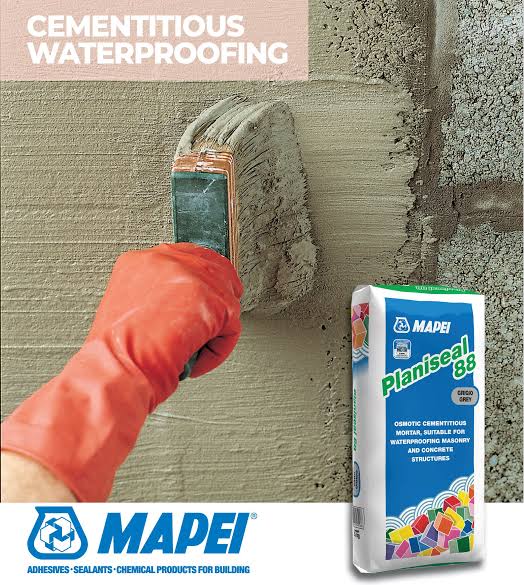
Planiseal 88 Cementitious Waterproofing Mortar 25KG
MAPEI PLANISEAL 88 25KG – CEMENTITIOUS WATERPROOFING MORTAR PRICE IN KENYA
Price: KSh 5,220 per 25kg bag – Inclusive of VAT
Brand: Mapei
Product: Planiseal 88
Former product name: Idrosilex Pronto
Product category: Cementitious Waterproofing Mortar
Packaging: 25kg bag
Colour: Grey or white, subject to availability
Application: Concrete and masonry waterproofing
Supplier: Startcore Ventures Limited, Nairobi, Kenya
1. Product Overview – What Is Mapei Planiseal 88?
Mapei Planiseal 88 is a one-component, osmotic cementitious waterproofing mortar developed for waterproofing suitable concrete and masonry structures. It is designed to create a protective mineral-based waterproofing layer on properly prepared surfaces exposed to moisture and water pressure.
Available from Startcore Ventures Limited at KSh 5,220 inclusive of VAT per 25kg bag, Planiseal 88 is a product to consider for selected waterproofing applications involving basement walls, cellar walls, foundations, irrigation channels, swimming pools, concrete tanks and masonry structures.
Formerly known as Idrosilex Pronto, Planiseal 88 is supplied as a pre-formulated dry powder. It is mixed with clean water on site and applied using a brush, trowel or suitable spray equipment, depending on the application and required consistency.
Unlike ordinary cement slurry, Planiseal 88 is a specialist waterproofing mortar developed for applications where a properly bonded cementitious coating is required to help restrict water penetration through compatible concrete and masonry substrates.
It is particularly relevant to contractors and waterproofing specialists working on water-retaining structures, damp underground walls and concrete surfaces requiring a cement-based waterproofing treatment.
The product's published Mapei literature identifies waterproofing performance up to 1 bar and suitability for contact with drinking water. These are important characteristics when assessing products for water-retaining structures. However, the project designer should confirm the applicable technical documentation, approvals and installation requirements before specifying it for potable-water applications.
Planiseal 88 is not a universal solution for every water-ingress problem. Active leaks, moving structural cracks, defective joints and unstable substrates must be assessed and treated appropriately before waterproofing begins.
2. Key Features of Mapei Planiseal 88
Cementitious Waterproofing Technology
Planiseal 88 is a cement-based waterproofing mortar. When mixed with the specified amount of water, it forms a workable mixture that can be applied to suitable concrete and masonry surfaces.
Once applied and properly cured, the material forms a cementitious waterproofing layer intended to reduce water penetration through the treated substrate.
This makes it useful for selected construction and rehabilitation projects where a cement-based waterproofing treatment is required.
Osmotic Waterproofing Action
Mapei identifies Planiseal 88 as an osmotic cementitious mortar. Osmotic waterproofing materials are formulated to interact with water and the mineral substrate to help create a water-resistant barrier.
The product is intended for compatible concrete and masonry structures rather than painted surfaces, plasterboard or general decorative finishes.
The substrate must be correctly prepared to achieve the intended bond and waterproofing performance.
Suitable for Concrete and Masonry
Planiseal 88 can be applied to suitable concrete, bricks and blocks.
This gives contractors flexibility when treating different mineral-based construction surfaces, provided the substrate is sound, stable, clean and prepared according to the manufacturer's instructions.
Suitable for Selected Water-Retaining Structures
Mapei's published product information identifies Planiseal 88 as suitable for applications involving water-retaining structures and contact with drinking water.
Potential applications include suitable concrete tanks, swimming pools and other structures where the product's technical requirements are met.
For drinking-water tanks, verify the current product documentation and any project-specific potable-water approval requirements before application and commissioning.
Application by Brush, Trowel or Spray
Planiseal 88 can be applied by brush, trowel or suitable spray equipment.
The application method depends on the required consistency, substrate profile, project details and manufacturer's recommendations.
Brush application is particularly useful when applying a cementitious coating over suitably prepared concrete or masonry surfaces.
Waterproofing Performance up to 1 Bar
Mapei's published product literature identifies waterproofing performance up to 1 bar.
This is a manufacturer-stated performance characteristic, not a guarantee that the product will solve every water-pressure problem.
The actual project must be assessed for water pressure, substrate condition, cracks, joints, penetrations and the required waterproofing system.
3. Where Is Mapei Planiseal 88 Used?
Planiseal 88 is intended for selected concrete and masonry waterproofing applications. The following examples explain where it may be considered.
A. Underground and Basement Wall Waterproofing
Basement walls and underground structures are exposed to moisture from surrounding soil, groundwater and rainfall.
Water can penetrate through porous concrete, masonry joints, construction defects and poorly detailed penetrations. Over time, this may result in damp patches, deterioration of internal finishes and damage to stored materials or building services.
Planiseal 88 can be considered for suitable underground concrete and masonry walls where a cementitious waterproofing layer is specified.
Before application, the contractor should:
- Identify the source of water ingress.
- Remove loose coatings, paint and unsound material.
- Repair suitable surface defects and prepare the substrate.
- Stop active water leaks using an appropriate water-plugging material.
- Ensure the surface is in the moisture condition required by the manufacturer.
- Apply Planiseal 88 at the specified thickness and number of coats.
- Protect the fresh coating during curing.
Where groundwater pressure is significant, the waterproofing design must account for the direction and magnitude of water pressure. Planiseal 88 should not be assumed to replace a specialised below-ground waterproofing system where the project requires one.
B. Concrete Water Tank Waterproofing
Concrete water tanks require a waterproofing system that is compatible with the tank construction and intended water use.
Water may escape through porous concrete, construction joints, cracks and poorly sealed pipe penetrations.
Planiseal 88 is identified by Mapei as suitable for contact with drinking water, making it a product worth considering for appropriate water-retaining structures.
Before using it in a tank, confirm:
- The tank is structurally sound.
- Cracks and construction joints have been properly assessed.
- Active leaks have been stopped.
- The substrate is prepared according to the technical data sheet.
- The product is suitable for the intended water contact.
- The required coating thickness and curing period are followed.
- The tank is tested and commissioned according to the project specification.
For potable-water tanks, do not rely solely on a general product description. Obtain the applicable manufacturer's documentation and confirm that it meets the approval requirements for the specific project and jurisdiction.
C. Swimming Pool Waterproofing
Swimming pools require careful waterproofing because the internal surface is continuously exposed to water once the pool is commissioned.
Planiseal 88 is listed in Mapei's product literature for swimming-pool applications. It may be considered for compatible concrete and masonry substrates where the specified waterproofing system permits its use.
Pool construction requires more than applying a coating to the visible surface. The contractor must consider:
- Concrete condition and curing.
- Structural cracks and movement joints.
- Pipe penetrations and fittings.
- Wall-to-floor junctions.
- Surface preparation.
- Required waterproofing thickness.
- Compatibility with the pool's finishing system.
- Curing and water-filling requirements.
Where a flexible waterproofing system is required to accommodate limited substrate movement, compare Planiseal 88 with an appropriate flexible Mapei system such as Mapelastic Smart.
These products are not interchangeable. The correct choice depends on the pool design and the manufacturer's approved system details.
D. Irrigation Channels and Water-Conveying Structures
Irrigation channels and water-conveying structures can experience continuous or repeated water exposure.
Poor concrete quality, surface porosity and construction joints may contribute to water loss and deterioration.
Planiseal 88 is identified in Mapei's published product information for irrigation-channel applications.
For these projects, the substrate must be sound and properly prepared. Construction joints, movement joints and significant cracks require appropriate detailing rather than simply covering them with waterproofing mortar.
The designer should also consider water pressure, flow conditions, abrasion and the maintenance requirements of the channel.
E. Exterior Cellar Walls and Damp Areas
Damp cellar walls can be caused by groundwater, poor drainage, defective external waterproofing or moisture travelling through masonry.
Planiseal 88 may be considered for suitable prepared mineral substrates where the product's application conditions are met.
However, it is important to distinguish water ingress from condensation.
If moisture is caused by poor ventilation, cold surfaces or internal condensation, applying a cementitious waterproofing coating alone may not solve the problem.
Correct diagnosis is essential before selecting a waterproofing product.
F. Foundation Wall Waterproofing
Foundation walls are exposed to soil moisture and potentially groundwater pressure.
Planiseal 88 may be relevant for selected concrete and masonry waterproofing applications, but the waterproofing design must consider the actual below-ground conditions.
Where the project requires a flexible system designed for foundation waterproofing and hydrostatic pressure, compare it with Mapei Mapelastic Foundation.
View the Mapei Mapelastic Foundation Waterproofing System.
4. Technical Specifications of Mapei Planiseal 88
The following information is based on Mapei's published Planiseal 88 product literature. The current regional technical data sheet should be checked before application.
Specification Product information
Brand | Mapei
Product name | Planiseal 88
Former name | Idrosilex Pronto
Product type | Osmotic cementitious waterproofing mortar
Appearance | Dry powder
Packaging | 25kg bag
Available colours | Grey or white, depending on supply
Suitable substrates | Concrete, bricks and blocks
Application methods | Brush, trowel or spray
Mixing water | Approximately 5.25–5.75 litres per 25kg bag
Approximate consumption | 1.5kg/m² per mm of thickness
Published waterproofing performance | Up to 1 bar
Drinking-water contact | Identified as suitable in Mapei product literature
Published standards | EN 1504-2 and related product classifications stated in Mapei literature
Technical note: Mixing water, application thickness, recoat intervals and curing requirements must be checked against the current regional Mapei technical data sheet. Product literature from different markets may contain variations.
5. How to Apply Mapei Planiseal 88
Correct preparation and installation are essential. A waterproofing product cannot compensate for an unstable substrate, untreated active leaks or poorly detailed joints.
The following is a general application sequence based on Mapei's published guidance. The current technical data sheet and project specification take precedence.
Step 1: Inspect the Substrate
Inspect the concrete or masonry before beginning work.
Identify:
- Cracks and damaged sections.
- Loose or hollow material.
- Paint and previous coatings.
- Oil, grease and other contamination.
- Construction joints.
- Pipe penetrations.
- Active water leaks.
- Areas showing signs of structural movement.
If the substrate is structurally damaged, obtain the necessary assessment and repairs before waterproofing.
Step 2: Remove Unsuitable Materials
Remove paint, loose coatings, dust, weak cementitious material and other contaminants that may prevent proper bonding.
The surface should be sound, stable and clean.
Do not apply Planiseal 88 over unsuitable coatings or weak material simply to save preparation time. The waterproofing layer depends on the condition of the substrate beneath it.
Step 3: Treat Active Water Leaks
Active water leaks should be stopped before applying Planiseal 88.
Mapei's outline specification identifies Lamposilex as a suitable product for treating active water leaks in the relevant repair sequence.
For emergency water stopping, consider Mapei Lamposilex ME Water Plug.
The water-plugging product and waterproofing mortar serve different purposes. Lamposilex is intended for rapid water stopping in suitable conditions, while Planiseal 88 provides the broader cementitious waterproofing treatment.
Step 4: Prepare and Saturate the Surface
Prepare the surface in accordance with the manufacturer's instructions.
Mapei's published outline specification describes saturating the substrate with clean water before application, leaving it in a saturated surface-dry condition without standing water.
Do not apply the product onto a surface with uncontrolled ponding water.
Step 5: Mix Planiseal 88
Pour approximately 5.25–5.75 litres of clean water into a suitable clean mixing container, then gradually add the 25kg powder while mixing with a suitable electric mixing paddle.
Mix until a consistent, homogeneous mixture is obtained.
Allow the mixture to stand for approximately 10 minutes and remix before application, as specified in the published Mapei instructions.
Do not mix by hand where the manufacturer specifies mechanical mixing.
Do not add cement, sand, aggregates or other admixtures unless expressly permitted by the manufacturer.
Do not add excess water to make the product easier to apply. Incorrect water content can affect the final performance.
Step 6: Apply the First Coat
Apply the prepared mortar using a suitable brush, trowel or spray equipment.
For brush application, Mapei's published guidance describes applying two to three coats, with the specified overall thickness.
Ensure the material is distributed evenly and worked into the prepared surface.
Pay particular attention to corners, wall-to-floor junctions and other detailed areas.
Step 7: Apply Subsequent Coats
Allow the previous coat to dry sufficiently before applying the next coat.
Mapei's published waterproofing guidance gives an indicative interval of approximately 5–6 hours between brush-applied coats, subject to conditions and the specific instructions.
Apply the subsequent coat in the recommended direction to help achieve even coverage.
The required final thickness must be established from the current technical data sheet and project specification.
Step 8: Protect and Cure
Fresh cementitious waterproofing should be protected from conditions that may cause premature drying or interfere with curing.
Follow the manufacturer's curing instructions, including any requirements for protection from direct sunlight, wind, rain or premature water exposure.
Do not fill a water tank or swimming pool until the specified curing and commissioning requirements have been met.
6. Mapei Planiseal 88 Coverage and Material Estimation
Mapei's published product literature gives an indicative consumption of approximately 1.5kg per square metre per millimetre of thickness.
This means the amount required depends on the total surface area and specified coating thickness.
The following examples use the published consumption rate for estimating purposes.
Surface areaAt 1mm thicknessAt 2mm thickness
1m² | 1.5kg | 3kg
5m² | 7.5kg | 15kg
10m² | 15kg | 30kg
20m² | 30kg | 60kg
50m² | 75kg | 150kg
100m² | 150kg | 300kg
Approximate coverage per 25kg bag
At the published rate:
- At 1mm thickness: approximately 16.7m².
- At 2mm thickness: approximately 8.3m².
- At 2.5mm thickness: approximately 6.7m².
These are theoretical estimates. Actual coverage depends on substrate roughness, surface profile, application method, wastage and the required system thickness.
For procurement, allow for the condition of the surface and the actual specified application thickness. Do not use theoretical coverage as a substitute for a measured site estimate.
7. Planiseal 88 Compared With Other Mapei Waterproofing Products
Selecting a waterproofing product based only on price or brand can lead to an unsuitable system. Mapei has several products designed for different applications.
Planiseal 88 vs Mapelastic Smart
Planiseal 88 is an osmotic cementitious waterproofing mortar. Mapelastic Smart is a two-component flexible cementitious waterproofing membrane.
The main distinction is the product formulation and intended performance.
Planiseal 88 may be considered for suitable concrete and masonry waterproofing, including applications listed by Mapei involving water-retaining structures.
Mapelastic Smart is designed for specified applications where a flexible cementitious waterproofing system is required, including selected balconies, terraces, bathrooms and swimming pools.
If the project requires flexibility and accommodation of limited substrate movement, Mapelastic Smart may be the more appropriate product, subject to the technical specification.
View Mapei Mapelastic Smart Waterproofing System.
Planiseal 88 vs Mapelastic Foundation
Mapelastic Foundation is a two-component waterproofing system intended for relevant foundation and underground applications.
Planiseal 88 is a one-component cementitious waterproofing mortar.
Where the project involves below-ground structures subject to specific hydrostatic-pressure conditions, compare the intended applications and technical performance of both products before selection.
View Mapei Mapelastic Foundation.
Planiseal 88 vs Lamposilex ME
These products perform different functions.
Planiseal 88 is used to create a cementitious waterproofing layer on suitable concrete and masonry surfaces.
Lamposilex ME is a rapid-setting water-plugging product intended for suitable active water leaks.
Where active water is entering through a localised hole or leak, it may be necessary to stop the leak first before applying the wider waterproofing treatment.
View Mapei Lamposilex ME.
Planiseal 88 vs Mapei Mapelastic Smart for Swimming Pools
Both products appear in Mapei's waterproofing portfolio, but they should not be treated as interchangeable.
The pool designer or contractor should confirm the selected product's suitability for the pool construction, water exposure, finishing system and movement requirements.
Where flexibility is important, the technical properties of Mapelastic Smart should be evaluated against the project specification.
Planiseal 88 vs Ordinary Cement Slurry
Ordinary cement slurry is not automatically an equivalent substitute for a formulated waterproofing mortar.
Planiseal 88 is a specialist product with defined mixing and application requirements. Substituting ordinary cement and water may not provide the intended waterproofing performance.
8. Related Mapei Products Available from Startcore
For customers undertaking waterproofing, concrete repair and construction rehabilitation projects, the following products may also be relevant.
- Mapei Mapelastic Smart Waterproofing System – a two-component flexible cementitious waterproofing system for specified applications such as balconies, terraces, bathrooms and swimming pools.
- Mapei Mapelastic Foundation – a two-component waterproofing system for relevant foundation and underground applications.
- Mapei Lamposilex ME Water Plug – a rapid-setting product for stopping suitable active water leaks before subsequent waterproofing work.
- Mapei Eporip 2kg Epoxy Adhesive – a two-component epoxy adhesive for specified concrete bonding and construction-joint applications.
- Mapei Mapegrout T60 Structural Repair Mortar – a structural concrete repair mortar for suitable concrete restoration applications.
These products serve different purposes. A complete waterproofing or concrete-repair project may require more than one product, but compatibility and installation sequence should always be confirmed before combining materials.
9. Related Waterproofing and Mapei Resources
For additional guidance on selecting construction chemicals and planning waterproofing work in Kenya, explore these Startcore Resource Centre articles:
- Mapei Products in Kenya: Waterproofing, Tile Adhesives, Concrete Repair and Flooring – an overview of Mapei product categories and how to approach product selection for different construction applications.
- Waterproofing in Kenya: Complete Guide to Roof, Concrete, Foundation and Tank Waterproofing – guidance on waterproofing systems, surface preparation, foundations, concrete, tanks and common causes of waterproofing failure.
10. Frequently Asked Questions About Mapei Planiseal 88
1. What is Mapei Planiseal 88 used for?
Planiseal 88 is an osmotic cementitious waterproofing mortar for suitable concrete and masonry structures. Mapei identifies applications including cellar walls, damp areas, foundation walls, irrigation channels, swimming pools and water-retaining structures.
2. What is the price of Mapei Planiseal 88 in Kenya?
The Startcore selling price is KSh 5,220 per 25kg bag, inclusive of VAT.
3. Is Planiseal 88 suitable for drinking-water tanks?
Mapei's published product literature identifies Planiseal 88 as suitable for contact with drinking water. For a specific potable-water project, obtain the current technical documentation and verify the applicable approval requirements before specifying it.
4. Can Planiseal 88 be used for swimming pools?
Mapei lists swimming pools among its product applications. The pool design, substrate, joints, finishing system and water exposure must still be checked against the current technical data sheet.
5. Can Planiseal 88 be applied to basement walls?
It may be considered for suitable prepared concrete and masonry basement or cellar walls. The source of water ingress and the pressure conditions should be assessed before application.
6. How much water is needed to mix one 25kg bag?
Mapei's published application guidance specifies approximately 5.25–5.75 litres of water per 25kg bag. Confirm the current regional product instructions before mixing.
7. What is the coverage of one 25kg bag?
The published consumption is approximately 1.5kg/m² per millimetre of thickness. At 2mm, a 25kg bag theoretically covers about 8.3m². Actual coverage depends on the substrate and application conditions.
8. Can Planiseal 88 be applied by brush?
Yes. Mapei identifies brush application as one of the available methods. It can also be applied by trowel or suitable spray equipment, depending on the required consistency and application.
9. Can Planiseal 88 stop active water leaks?
Do not rely on Planiseal 88 alone to stop active water flowing through a hole or localised leak. Active leaks should be treated using an appropriate water-stopping method before the broader waterproofing treatment.
10. Is Planiseal 88 flexible?
It is an osmotic cementitious waterproofing mortar, not a flexible membrane equivalent to Mapelastic Smart. If the project requires flexibility to accommodate substrate movement, evaluate a suitable flexible waterproofing system.
11. Can Planiseal 88 be applied over paint?
Do not apply it over paint or unsuitable existing coatings. Mapei's published preparation guidance requires the removal of paint and other coatings so that the substrate is sound, stable and clean.
12. Is Planiseal 88 suitable for all types of walls?
No. It is intended for suitable concrete, bricks and blocks. It should not be treated as a universal coating for painted walls, plasterboard, timber or unstable surfaces.
13. How long should Planiseal 88 cure before filling a water tank?
Follow the current manufacturer's curing and commissioning requirements. Do not fill the tank simply because the surface appears dry. The required period depends on the product instructions and site conditions.
14. Is Planiseal 88 the same as Idrosilex Pronto?
Planiseal 88 was formerly known as Idrosilex Pronto. The current product name is Planiseal 88.
15. Where can I buy Mapei Planiseal 88 in Nairobi?
You can enquire and order from Startcore Ventures Limited, located at Bhavesh Centre, Mezzanine Floor, Office M1C, Ngara Road, Nairobi.
11. Buy Mapei Planiseal 88 25kg in Kenya from Startcore Ventures Limited
When selecting a waterproofing mortar, it is important to match the product to the structure, water exposure and substrate. Planiseal 88 provides a cementitious waterproofing option for suitable concrete and masonry applications, including selected water-retaining structures.
Startcore Ventures Limited supplies construction chemicals, waterproofing systems, concrete repair products, adhesives and sealants to contractors, developers, engineers, maintenance teams and other construction buyers in Kenya.
Product: Mapei Planiseal 88 Cementitious Waterproofing Mortar
Pack size: 25kg
Price: KSh 5,220 inclusive of VAT
Contact Startcore Ventures Limited
Sales and WhatsApp: 0705 544 817
Office: 0737 636 611
Email: [email protected]
Website: www.startcore.co.ke
Location: Bhavesh Centre, Mezzanine Floor, Office M1C, Ngara Road, Nairobi, Kenya.
For a quotation, provide the product name, project location, estimated surface area, substrate type and intended application. For tanks, swimming pools and underground structures, include the relevant project details so that the product requirements can be assessed.
Order Mapei Planiseal 88 from Startcore Ventures Limited at KSh 5,220 inclusive of VAT per 25kg


