

 Waterproofing
IN STOCK
Product video
 Mapei
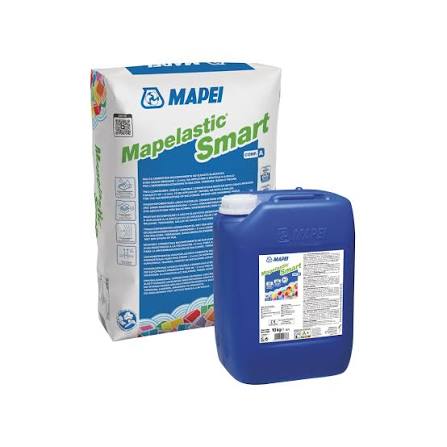
MAPELASTIC SMART WATERPROOFING SYSTEM (SET A+B)
Mapei Mapelastic Smart Waterproofing Membrane 30kg – Flexible Cementitious Waterproofing System in Kenya
Price: KSh 13,585 inclusive of VAT
Mapei Mapelastic Smart is a two-component, flexible cementitious waterproofing membrane designed to protect suitable concrete and masonry structures against water penetration. It is suitable for applications including balconies, terraces, bathrooms, swimming pools and other compatible structures where a flexible waterproofing layer is required beneath an appropriate finish.
Available from Startcore Ventures Limited in Nairobi, Kenya, Mapelastic Smart combines a cement-based powder with a liquid polymer component to create a brushable, roller-applied or spray-applied waterproofing mortar. Once properly applied and cured, the system forms a continuous membrane designed to accommodate limited substrate movement and help prevent water from passing through the treated surface.
For Kenyan construction projects, this makes Mapelastic Smart a product worth considering for wet rooms, tiled balconies, concrete terraces, swimming pools and other suitable waterproofing applications where surface preparation, crack detailing and correct membrane thickness are essential.
Buy Mapei Mapelastic Smart 30kg for KSh 13,585 inclusive of VAT from Startcore Ventures Limited. Contact our team for product availability, quantity planning and assistance selecting a waterproofing system for your project.
Product specifications at a glance
- Brand: Mapei
- Product: Mapelastic Smart
- Product type: Two-component flexible cementitious waterproofing membrane
- Pack size: 30kg combined kit
- Component A: 20kg cement-based powder
- Component B: 10kg liquid polymer component
- Mixing ratio: 2 parts Component A to 1 part Component B by weight
- Application methods: Brush, roller, trowel or suitable spray equipment, depending on the application
- Minimum application: At least two coats, with the required total thickness determined by the project specification
- Price inclusive of VAT: KSh 13,585
- Supplier: Startcore Ventures Limited, Nairobi, Kenya
1. What is Mapei Mapelastic Smart?
Mapei Mapelastic Smart is a high-flexibility, two-component cementitious waterproofing membrane. It is designed for internal and external applications where a flexible barrier is required to protect suitable building surfaces from water ingress.
The system combines two materials supplied together:
Component A – 20kg powder: The cement-based powder component provides the mineral matrix of the waterproofing mortar.
Component B – 10kg liquid: The liquid polymer component contributes to the flexibility and performance of the mixed membrane.
When the components are mixed in the prescribed ratio, they form a homogeneous paste that can be applied to the prepared substrate. Once cured, the resulting layer provides waterproofing protection and can accommodate limited cracking and movement within the performance limits of the system.
Mapelastic Smart is not simply a surface paint or a general-purpose cement slurry. It is a formulated waterproofing system that must be mixed and applied according to the manufacturer's technical instructions.
Correct preparation, reinforcement of vulnerable details, sufficient material consumption and appropriate curing are all important to achieving the intended result.
2. Why use Mapelastic Smart for waterproofing in Kenya?
Water ingress is a common concern in buildings exposed to seasonal rainfall, leaking balconies, wet rooms, poorly detailed roof terraces and inadequate waterproofing beneath tiles.
A waterproofing system must do more than cover the visible surface. It needs to form a continuous barrier, adhere to the prepared substrate and remain suitable for the conditions expected during the building's service life.
Mapelastic Smart can be considered where a flexible cementitious membrane is appropriate for the intended application.
Its key benefits include:
- Flexibility: Designed to accommodate limited substrate movement within the system's performance limits.
- Crack-bridging capability: Mapei documentation describes crack-bridging performance exceeding 2mm under specified test conditions.
- Two-component formulation: The powder and liquid components are supplied as a matched system.
- Multiple application methods: Can be applied using a suitable brush, roller, trowel or spray equipment.
- Tiled-finish compatibility: Suitable for use beneath compatible tile finishes when the required curing and installation procedures are followed.
- Internal and external applications: Intended for suitable areas such as bathrooms, balconies, terraces and swimming pools.
- Concrete protection: Can help protect compatible concrete surfaces from water ingress when correctly specified and installed.
These benefits do not mean that Mapelastic Smart can compensate for defective drainage, structural movement, an unstable substrate or incorrectly treated construction joints. The waterproofing system must be selected and installed as part of the complete building detail.
3. Where can Mapelastic Smart be used?
A. Bathroom waterproofing
Bathrooms are among the most important areas to waterproof because water can escape through floor junctions, pipe penetrations, shower corners and poorly sealed interfaces.
Mapelastic Smart may be specified for suitable bathroom floors and walls before tiling, subject to the substrate and manufacturer's instructions.
Typical applications include:
- Residential bathroom floors.
- Shower areas.
- Bathroom wall-to-floor junctions.
- Wet rooms in apartments and maisonettes.
- Hotel bathrooms.
- Changing rooms and other suitable wet areas.
Particular attention should be paid to floor drains, pipe outlets, internal corners and changes of plane. These locations require suitable detailing because the main floor area is only one part of the waterproofing system.
The membrane should be installed at the specified thickness, allowed to cure appropriately and covered with compatible tile adhesive and finishes where required.
Do not assume that grout alone provides the primary waterproofing barrier. The membrane beneath the tile finish is an important part of the specified system.
B. Balconies and open verandas
Balconies are exposed to rain, temperature changes and repeated wetting and drying. Water can penetrate through cracks, tile joints, slab edges, poorly sealed door thresholds and wall junctions.
Mapelastic Smart can be considered beneath compatible exterior tile finishes on suitable balcony substrates.
Important detailing areas include:
- The balcony slab and adjacent wall.
- Door thresholds.
- Parapet-to-floor junctions.
- Drainage outlets.
- Structural and movement joints.
- Penetrations through the waterproofing layer.
The waterproofing system must be designed with the intended finish and drainage arrangement in mind. A balcony with poor drainage or persistent standing water may require corrective work before waterproofing begins.
Do not bridge a genuine expansion joint with an ordinary membrane layer without the appropriate joint system. Movement joints need compatible detailing designed for the expected movement.
C. Concrete terraces and tiled roof decks
Concrete terraces can experience leakage through cracks, porous screed, poorly detailed upstands and interfaces with adjoining structures.
Mapelastic Smart may be suitable where the project requires a flexible cementitious waterproofing layer beneath compatible protective or tiled finishes.
For these projects, the installer should confirm:
- Whether the concrete or screed is structurally sound.
- Whether cracks are stable or actively moving.
- Whether the roof has adequate falls and drainage.
- Whether existing coatings or finishes must be removed.
- Which reinforcement and joint-detailing accessories are required.
- How the membrane will be protected during subsequent construction.
A waterproofing membrane should not be treated as a substitute for correcting major structural defects or inadequate drainage.
D. Swimming pools and suitable water-retaining structures
Mapelastic Smart is intended for suitable swimming-pool waterproofing applications, subject to the relevant system specification and local requirements.
For pool projects, the concrete shell must be sound, the substrate must be prepared correctly, and construction joints, corners and pipe penetrations must be detailed appropriately.
Before filling a pool, observe the manufacturer's specified curing period and testing procedure. The final finish, water chemistry, continuous immersion conditions and any local requirements should be considered during specification.
Do not assume that every water tank or potable-water installation is suitable simply because the product is used in swimming pools. Confirm the exact product documentation and applicable approval requirements for the intended use.
E. Foundations, retaining walls and basements
Below-ground waterproofing requires particular care because the structure may experience ground moisture or hydrostatic pressure from outside.
Mapelastic Smart may be appropriate for certain concrete and masonry waterproofing applications, but the direction and magnitude of water pressure, drainage design, substrate condition and access to the outside face must be evaluated.
Where a project involves significant negative water pressure, persistent groundwater or below-ground structures, select a product whose current technical documentation explicitly supports the intended conditions.
Mapei offers other specialised waterproofing products, including Mapelastic Foundation, for applications that may require a different system. The correct product should be chosen according to the project's specific requirements rather than assuming all cementitious membranes are interchangeable.
F. Commercial kitchens, laundries and communal wet areas
Hotels, apartment blocks, schools, gyms and commercial buildings often have wet areas that require waterproofing beneath tiled finishes.
Mapelastic Smart may be considered for suitable floors and walls in these settings, provided the system is compatible with the substrate, finish and expected exposure.
The design should account for drains, service penetrations, cleaning practices, construction joints and the type of finish to be installed.
Where industrial chemicals, extreme temperatures or unusual service conditions are expected, confirm suitability with the manufacturer before specifying the product.
4. Technical characteristics and performance
Mapei identifies Mapelastic Smart as a two-component flexible cementitious membrane for suitable waterproofing applications.
Its published product information includes the following characteristics:
Characteristic Product information
Formulation | Two-component cementitious membrane
Component A | 20kg powder
Component B | 10kg liquid
Total kit weight | 30kg
Mixing ratio | 2:1 by weight, powder to liquid
Minimum application | At least two coats
Minimum specified thickness | 2mm in two coats in the cited product documentation
Pot life | Approximately 1 hour under stated conditions
Recoat interval | Approximately 4–5 hours under stated conditions
Application temperature | Product documentation specifies a range beginning around +5°C and extending to +40°C, depending on the applicable regional technical sheet
Manual application consumption | Approximately 1.6kg/m² per mm of thickness
Spray application consumption | Approximately 2.2kg/m² per mm of thickness
Crack-bridging performance | Greater than 2mm under specified test conditions
Values may vary by regional product documentation and application specification. Always follow the current technical data sheet supplied for the product sold into your market.
The published crack-bridging figure is a test result, not permission to coat any active structural crack without repair or suitable joint treatment.
5. How much area does one 30kg kit cover?
Coverage depends on the thickness required, application method, substrate profile and material lost during application.
Mapei's published consumption figures are approximately:
- Brush, roller or trowel application: 1.6kg/m² per millimetre of thickness.
- Spray application: 2.2kg/m² per millimetre of thickness.
For preliminary planning, the following estimates use the manual-application consumption figures. Actual consumption may be higher on uneven or porous surfaces.
Illustrative coverage for a 30kg kit
Total dry-thickness specification Approximate consumptionTheoretical coverage per 30kg kit
2.0mm | 3.2kg/m² | 9.4m²
2.5mm | 4.0kg/m² | 7.5m²
3.0mm | 4.8kg/m² | 6.25m²
These are estimates, not guaranteed coverage figures. The appropriate thickness must be established from the current technical documentation and project specification.
Example: waterproofing a 20m² bathroom and wet area
If the specified system requires a consumption of 3.2kg/m²:
20m² × 3.2kg/m² = 64kg of mixed product.
This would require at least three 30kg kits after rounding up to whole kits, before allowing for additional waste, surface irregularities or reinforcement details.
If a higher consumption is specified, the quantity will increase. Always calculate material quantities using the actual application specification rather than assuming every kit covers the same area.
6. Mixing and application procedure
Step 1: Inspect the substrate
Before mixing, inspect the concrete, screed or masonry for cracks, loose material, honeycombing, laitance, grease, dust and other contaminants.
Repair defects with a suitable repair material and allow the repairs to cure as specified. Active structural cracks and movement joints require appropriate assessment and detailing.
Step 2: Prepare the surface
Remove loose material and contaminants that could interfere with adhesion. The substrate should be sound and prepared according to the product instructions.
For cementitious substrates, follow the applicable technical sheet regarding moisture condition and priming. Do not leave standing water on the surface.
Where the substrate is particularly porous, contaminated or previously coated, obtain advice on the correct preparation and primer system.
Step 3: Measure the components
The standard kit consists of 20kg of Component A and 10kg of Component B.
The prescribed ratio is two parts powder to one part liquid by weight. Use the supplied components as a matched system and do not add extra water, sand or cement unless the manufacturer expressly instructs otherwise.
Step 4: Mix mechanically
Pour the liquid component into a clean mixing container and gradually add the powder while mixing with a suitable low-speed mechanical mixer.
Continue until a smooth, homogeneous mixture is obtained. Avoid leaving dry powder or lumps in the mixture.
Do not mix more material than can be applied within the stated working time. Under the manufacturer's stated conditions, the mixed product has a pot life of approximately one hour.
Actual working time depends on temperature and site conditions.
Step 5: Apply the first coat
Apply the mixed material using a suitable brush, roller, trowel or spray equipment, as appropriate for the job.
Work the material consistently across the surface and pay particular attention to corners, junctions and penetrations.
The aim is to form a continuous layer without pinholes, missed areas or excessively thin patches.
Step 6: Reinforce vulnerable details
Use compatible reinforcement accessories where required by the system specification. Mapei's waterproofing systems include accessories such as Mapeband and reinforcement meshes for suitable joints, corners and connection details.
The correct accessory depends on the location and expected movement. Do not treat an ordinary reinforcement mesh as a substitute for a purpose-designed expansion-joint detail.
Step 7: Apply the second coat
Allow the first coat to reach the required condition before applying the next coat. Published documentation indicates a typical interval of approximately four to five hours under specified conditions.
Apply the second coat evenly, generally in a direction crossing the first where appropriate to the system instructions.
Confirm that the required total thickness and material consumption have been achieved.
Step 8: Cure and protect the membrane
Protect the fresh membrane from adverse weather, physical damage and premature covering.
Do not rush tiling, immersion or flood testing. The appropriate waiting time depends on the application, the environmental conditions and the current manufacturer's instructions.
For example, the cited regional Mapelastic Smart documentation identifies separate waiting periods for subsequent applications, flood testing and full immersion. Confirm the applicable timing for the exact project before proceeding.
Step 9: Install the final finish
Where tiling is specified, use a compatible tile adhesive suitable for the substrate, tile type and exposure conditions.
Avoid damaging the waterproofing layer while moving tools, materials or tiles across the surface.
The complete system should be inspected before it is covered, and the contractor should document the products used and the application process.
7. Common waterproofing mistakes to avoid
Applying over a weak substrate
A flexible membrane cannot compensate for loose screed, poorly bonded plaster or unsound concrete. Remove or repair defective material before application.
Incorrect mixing ratio
Changing the ratio between Components A and B can alter the intended properties of the mixed product. Use the supplied kit and the manufacturer's specified ratio.
Adding water or cement without approval
Unapproved additions can change the material's consistency and performance. Do not modify the mixture unless the technical documentation specifically permits it.
Applying too little material
Insufficient consumption can produce a layer that does not meet the specified thickness. Calculate quantities before beginning and monitor the application.
Ignoring joints and penetrations
Water commonly enters through drains, pipe penetrations, construction joints and changes of plane. Detail these locations with compatible accessories and the prescribed system.
Covering the membrane too early
Premature tiling, filling or exposure can interfere with curing. Follow the appropriate waiting periods for the actual conditions.
Assuming the membrane repairs structural movement
A crack-bridging membrane is not a replacement for structural repair. Active cracks, expansion joints and major defects require an appropriate solution.
Using one product for every waterproofing problem
A bathroom, an exposed terrace, a basement under hydrostatic pressure and a potable-water tank may have different requirements. Select the waterproofing system for the actual exposure.
8. Safety, storage and handling
Mapelastic Smart is intended for professional construction use. Follow the latest product and safety data sheets.
Component A is a cement-based powder and can cause irritation. During mixing and application, use suitable gloves, eye protection, work clothing and respiratory protection appropriate to the task.
Avoid inhaling dust and prevent contact with eyes and skin. If material enters the eyes, rinse immediately with clean water and obtain medical advice as directed by the safety data sheet.
Keep the components in their original, sealed packaging in a dry and appropriate storage environment. The cited Mapei documentation gives a storage period of up to 12 months for Component A and up to 24 months for Component B under the specified storage conditions.
Check the packaging for the actual batch information and expiry date. Do not use material that has deteriorated or been stored outside the recommended conditions.
Clean tools with water while the material is still fresh. Once the mortar has set, removal may require mechanical methods.
9. Frequently asked questions
What is the price of Mapei Mapelastic Smart in Kenya?
The current Startcore listing price is KSh 13,585 inclusive of VAT for the 30kg kit.
What comes in a 30kg kit?
The kit contains a 20kg powder component and a 10kg liquid component, supplied together as the two-component waterproofing system.
Can Mapelastic Smart be used in bathrooms?
Yes, it is intended for suitable bathroom waterproofing applications, including areas beneath compatible tile finishes. Correct preparation, junction detailing, thickness and curing are essential.
Can it be used on balconies and terraces?
Yes, suitable balconies and terraces are among the intended applications. The system must be specified according to the substrate, exposure, drainage and final finish.
Can Mapelastic Smart be used in swimming pools?
It is intended for suitable swimming-pool waterproofing applications. Follow the current product documentation, including curing and immersion requirements, and confirm suitability for the specific pool design and finish.
How many square metres does one kit cover?
Coverage depends on the specified thickness and application method. At approximately 3.2kg/m², a 30kg kit theoretically covers about 9.4m². At approximately 4.0kg/m², it covers about 7.5m² before waste and extra detailing.
How long should I wait between coats?
Published documentation gives a typical recoat interval of approximately four to five hours under specified conditions. Temperature, humidity and the actual substrate can affect drying.
Can tiles be installed directly over Mapelastic Smart?
Compatible tile finishes can be installed over the cured membrane using an appropriate tile adhesive. Follow the product-specific waiting period and the adhesive manufacturer's instructions.
Is Mapelastic Smart suitable for structural cracks?
It can accommodate limited crack movement within its documented performance limits. Active structural cracks and movement joints need appropriate assessment, repair and detailing.
Can it be used for a basement with water pressure?
Suitability depends on the direction and magnitude of the pressure and the particular construction detail. Where significant hydrostatic or negative pressure is involved, confirm that the chosen product is specifically suitable or consider a dedicated system such as Mapei Mapelastic Foundation.
Does the product include installation?
The listed price is for the 30kg product kit. Labour, surface preparation, reinforcement accessories, tile adhesive and installation services are separate unless expressly included in a written quotation.
10. Buy Mapei Mapelastic Smart from Startcore Ventures Limited
Choosing the right waterproofing system is important for contractors, developers, property owners and maintenance teams. The product must match the substrate, the expected water exposure and the finish being installed.
Startcore Ventures Limited supplies construction chemicals and waterproofing products to customers in Nairobi and across Kenya. Our team can help with product enquiries, material quantities and identifying a suitable product for your application.
Product: Mapei Mapelastic Smart Waterproofing System, 30kg
Price: KSh 13,585 inclusive of VAT
Website: https://www.startcore.co.ke/
Location: Bhavesh Centre, Mezzanine Floor, Office M1C, Ngara Road, Nairobi, Kenya.
Sales and WhatsApp: +254 705 544 817
Office: +254 737 636 611
Email: [email protected]
For technical selection, share the area to be waterproofed, substrate type, whether tiles will be installed, and whether the surface will be exposed to weather or continuous immersion. This helps establish the correct product quantity and application requirements.
Order Mapei Mapelastic Smart from Startcore Ventures Limited for KSh 13,585 inclusive of VAT.


