

Akfix EM600 Waterguard Waterproofing Membrane in Kenya: Roof Waterproofing, Application Guide, Cost per m² and Alternatives
Stop roof and terrace leaks with Akfix EM600 Waterguard in Kenya. Learn applications, installation at KSh 2,100/m², coverage, preparation, guarantees and comparisons with Mapei and Fosroc.
Akfix EM600 Waterguard Waterproofing Membrane in Kenya: Roof Waterproofing, Application Guide, Cost per m² and Alternatives
1. Introduction: A practical solution to roof and terrace leaks in Kenya
Water leaking through a flat roof, balcony, parapet or exposed terrace can create problems far beyond a wet ceiling. Persistent moisture damages paint, stains internal finishes, encourages mould growth, deteriorates plaster and may eventually affect other building components. For property owners, landlords, contractors and facilities managers in Kenya, the challenge is finding a waterproofing system that suits the existing surface, local weather conditions and intended use of the roof.
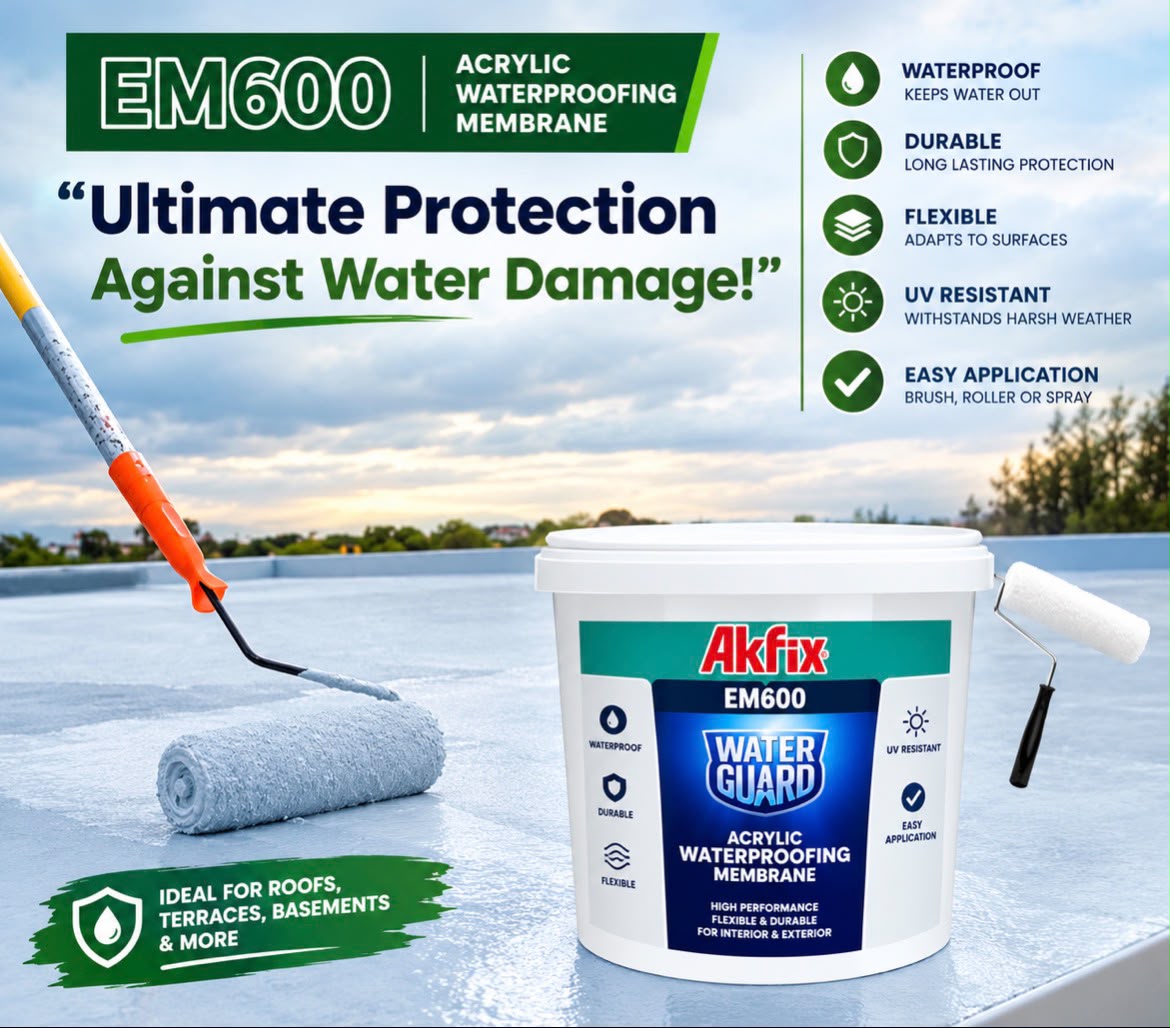
Akfix EM600 Waterguard Acrylic Waterproofing Membrane is a ready-to-use, water-based acrylic copolymer membrane designed to create a continuous, flexible waterproofing layer on suitable exterior surfaces. According to its technical data sheet, the product is suitable for roofs, balconies, terraces, facades, wooden surfaces, asphalt and bitumen flooring, and roofing details such as gutters and chimney edges.
The system is applied using a brush, roller or airless spray gun. Its water-based formulation, UV resistance, water-vapour permeability and high stated elongation make it a product worth considering for exposed surfaces that experience weather and normal thermal movement.
At Startcore Ventures Limited, the aim is not simply to supply a waterproofing product. It is to help the customer identify the source of water ingress, select a suitable system and understand the preparation and application required to achieve a dependable result.
For eligible projects, the proposed installation rate is KSh 2,100 per square metre, including a written installation workmanship guarantee subject to an agreed scope and site assessment. The final quotation should specify the preparation work, membrane application, any reinforcement, exclusions and guarantee conditions before work begins.
2. What is Akfix EM600 Waterguard?
Akfix EM600 is a one-component, water-based acrylic copolymer waterproofing membrane. It is supplied ready to use and forms a continuous elastic layer when properly applied and allowed to dry.
Unlike a waterproofing sheet, the liquid membrane is applied directly to the prepared substrate. This allows the coating to follow the shape of the surface and form a seamless layer over suitable areas. Corners, junctions, edges, penetrations and changes of plane still require careful detailing because these are common locations for water ingress.
Key product characteristics
- Ready to use: No separate two-part resin and hardener are required.
- Flexible membrane: The manufacturer reports elongation at break of at least 600% under DIN 53504 testing.
- UV resistant: Intended for exposure to sunlight in suitable exterior applications.
- Water-based formulation: The product does not contain solvent according to the supplied data sheet.
- Water-vapour permeable: Allows water vapour to pass through the membrane rather than acting as a completely vapour-impermeable barrier.
- Multiple application methods: Can be applied with a brush, roller or airless spray gun.
- Seamless application: Forms a continuous coating without the regular sheet joints found in some membrane systems.
- Overpaintable: Compatible finishing coats may be considered after checking product compatibility.
- Suitable for horizontal and vertical surfaces: The manufacturer’s stated application areas include roofs, terraces, balconies and facades.
These properties do not mean that EM600 is suitable for every waterproofing problem. The product is not intended for pressurised water and is not recommended for direct pedestrian or vehicle traffic without a suitable protective covering. The suitability of the substrate, water drainage, surface preparation and correct application thickness remain essential.
3. Where can Akfix EM600 be used in Kenya?
Kenyan buildings experience different combinations of rainfall, sunshine, heat, humidity and construction detailing. A suitable waterproofing specification should account for the actual building and exposure rather than relying on a product name alone.
A. Flat concrete roofs in Nairobi
Flat roofs are common in apartments, commercial buildings, offices, schools and residential developments. Their performance depends heavily on the slope, drainage outlets, parapets, expansion joints and the condition of the existing roof finish.
Where a concrete roof is sound, appropriately sloped and compatible with an acrylic membrane, EM600 can be considered as a liquid-applied waterproofing coating.
Typical project situations include:
- Rainwater entering through a weathered roof coating.
- Deteriorating exterior roof finishes.
- Localised leakage around roof details.
- Roof surfaces requiring a renewed exposed waterproofing layer.
- Planned maintenance before the next rainy period.
Before application, the contractor should check whether water drains properly, whether the existing coating is compatible, and whether the concrete is sound and dry. A coating should not be used to conceal structural cracks, loose screed or a drainage defect.
B. Terraces and balconies
Terraces and balconies are exposed to rain, sunlight and movement associated with temperature changes. Water may enter through hairline cracks, poorly sealed edges, wall junctions or penetrations.
EM600 may be considered for suitable exposed balcony and terrace surfaces where the membrane can remain protected from regular foot traffic or receive an appropriate protective finish.
Particular attention should be paid to:
- Junctions between the balcony slab and the building wall.
- Door thresholds and external frames.
- Parapet-to-floor connections.
- Drain outlets and downpipe connections.
- Cracks and existing movement joints.
- The slope towards the drainage outlet.
If the balcony is regularly used as a walking surface, the waterproofing must not simply be left exposed without assessing the need for a compatible protective system. The manufacturer’s data sheet specifically warns against direct pedestrian and vehicle traffic.
C. Parapets, external walls and facades
Rainwater can penetrate porous plaster, weathered exterior finishes and poorly detailed junctions. EM600’s stated application areas include facades, making it an option to assess for suitable exterior wall surfaces.
Applications may include:
- Weather-exposed rendered walls.
- Selected parapet surfaces.
- Exterior walls where a compatible flexible coating is required.
- Roof-to-wall junctions, with suitable reinforcement where necessary.
The surface must be structurally sound, clean and dry. Loose paint, chalking coatings, dust and contaminated material must be removed. The installer should check for rising damp, water entering from behind the wall and other moisture sources that a surface coating will not solve.
Because EM600 is a liquid membrane rather than a complete building-envelope repair system, failed flashings, open joints and defective roof drainage must also be corrected.
D. Metal roofing and selected mabati applications
Metal roofs can develop leakage around fasteners, laps, gutters, edges and interfaces with adjoining materials. The Akfix manufacturer lists metal roofs among the product’s application areas.
For a suitable metal substrate, preparation should include removing dirt, loose rust and other contaminants. The supplied technical data sheet recommends an anticorrosive primer for metal surfaces.
This is important because a waterproofing coating does not replace rust treatment or repair of a badly corroded sheet. Damaged roofing, failed screws, deteriorated washers and open laps may need physical repair before coating begins.
The installer must confirm compatibility with the specific metal, primer and existing roof coating before proceeding. Roof-sheet movement, ponding water and exposure conditions should be considered in the specification.
E. Gutters, chimney edges and roof penetrations
Small roof details can account for a disproportionate amount of leakage. Water may enter where a gutter meets the roof, around chimney edges, at upstands or where different materials meet.
EM600’s stated applications include gutters and chimney edges. These areas require careful preparation and detailing, rather than simply spreading the membrane over the visible leak.
Where a joint is cracked or likely to move, the manufacturer’s data sheet recommends reinforcing textile for connection lines or cracked surfaces. The appropriate reinforcement method and compatible materials should be confirmed for the actual detail.
F. Wooden surfaces and selected bitumen or asphalt surfaces
The manufacturer also lists wooden surfaces and asphalt or bitumen flooring as application areas. However, the exact condition and type of substrate matter.
For wood, the installer should assess moisture, movement, coatings and whether the substrate is suitable for the proposed membrane. For asphalt or bitumen, the condition of the existing layer, compatibility and risk of movement or contamination must be checked.
Do not assume that every timber deck, bituminous roof or previously coated surface is suitable without testing and reviewing the application requirements.
4. Why flexibility and UV resistance matter
An exposed roof experiences changes in temperature throughout the day. Concrete, metal, timber and other building materials can expand and contract at different rates. Existing cracks and construction junctions can also move.
A rigid coating may be vulnerable where the substrate moves beyond what it can accommodate. EM600 is an elastic acrylic membrane, and its technical data sheet reports elongation at break of at least 600%.
This is a laboratory property, not a guarantee that the membrane can bridge any crack or movement joint in a building. Crack width, movement, substrate condition, film thickness and reinforcement all influence actual performance.
Its UV resistance is also relevant to exposed roofs and terraces. Nevertheless, UV resistance does not remove the need for correct application thickness, sound preparation, effective drainage and maintenance.
The practical lesson: flexibility and weather resistance help, but they cannot compensate for a badly prepared roof or a structural problem.
5. Akfix EM600 technical specifications
The following values are taken from the manufacturer’s supplied technical data sheet.
| Property | Manufacturer’s stated value
| Chemical basis | Acrylic copolymer
| Solid content | 70–80%
| Density | 1.37 ± 0.03 g/ml
| Appearance | Liquid; white
| Viscosity | 50,000 ± 5,000, spindle No. 6 at 12 rpm and 20°C
| Elongation at break | At least 600%, DIN 53504
| Tensile strength | Greater than 1 N/mm², DIN 53504
| Horizontal consumption | Approximately 1.0–1.5 kg/m²
| Vertical consumption | Approximately 0.75 kg/m²
| Recoat interval | Approximately 4–5 hours at 23°C and 50% relative humidity
| Service time | Approximately 48 hours under stated test conditions
| Application temperature | +5°C to +35°C
| Storage life | 12 months when properly stored in the original packaging
| Storage conditions | +5°C to +25°C, dry and protected from direct sunlight
Drying and service times depend on the actual weather and site conditions. Cool temperatures, high humidity, poor ventilation or a thick application may affect drying. The stated service time should not be treated as permission to expose the membrane to rain immediately after installation.
6. How much EM600 is needed per square metre?
The manufacturer’s stated consumption is approximately 1.0–1.5 kg/m² for horizontal surfaces and 0.75 kg/m² for vertical surfaces. Actual consumption depends on substrate texture, porosity, application thickness, detailing and waste.
For a roof, terrace or balcony, use the horizontal consumption figure for preliminary budgeting.
Illustrative material quantities for horizontal surfaces
| Roof area | At 1.0 kg/m² | At 1.5 kg/m²
| 20 m² | 20 kg | 30 kg
| 50 m² | 50 kg | 75 kg
| 100 m² | 100 kg | 150 kg
| 150 m² | 150 kg | 225 kg
| 200 m² | 200 kg | 300 kg
A 20 kg drum would theoretically cover about 13.3–20 m² at those consumption rates. This is a planning estimate, not a guarantee of coverage. Rough concrete, porous screed, repairs, edges and reinforcement details can increase material demand.
For example, a 100 m² roof would require approximately 100–150 kg before allowing for waste or additional detailing. That is equivalent to five to eight 20 kg drums when rounded up to whole drums, depending on the actual specification.
Do not reduce consumption simply to make the installation cost fit a budget. Applying insufficient material can compromise the intended membrane thickness and increase the risk of failure.
7. Installation cost in Kenya: KSh 2,100 per square metre
For qualifying projects, Startcore’s proposed installation offer is KSh 2,100/m², with a written workmanship guarantee under agreed terms.
The final price should be confirmed following a site assessment. Waterproofing costs depend on roof condition, access, area, the number of details, existing coatings, repairs, reinforcement and the quantity of membrane needed.
Illustrative project budgets
| Area | Calculation | Indicative installation total
| 20 m² | 20 × KSh 2,100 | KSh 42,000
| 50 m² | 50 × KSh 2,100 | KSh 105,000
| 100 m² | 100 × KSh 2,100 | KSh 210,000
| 150 m² | 150 × KSh 2,100 | KSh 315,000
| 200 m² | 200 × KSh 2,100 | KSh 420,000
These are indicative totals based on the stated rate, not confirmed quotations for specific properties. The quotation should explicitly state whether VAT, access equipment, extensive repairs, reinforcement textile and protective finishes are included.
What should the standard installation include?
A clearly defined quotation should identify the following:
- Inspection of the accessible surface and identification of visible defects.
- Removal of loose dirt, dust, grease and unsound coating within the agreed scope.
- Minor preparation necessary for application to a sound substrate.
- Primer where required and compatible with the substrate.
- Application of EM600 in at least two coats, with the required drying interval and cross-direction application.
- Appropriate treatment of agreed connection lines and cracks, including reinforcement where specified.
- Final visual inspection and handover documentation.
Major screed replacement, structural crack repairs, extensive rust treatment, failed gutters, plumbing repairs, replacement of damaged roof sheets, scaffolding or other special access requirements should be identified and priced separately unless expressly included.
The guarantee: what the client should receive
A written installation workmanship guarantee should specify:
- Its duration and commencement date.
- The treated area and the agreed waterproofing system.
- The surface preparation and application scope.
- Any required protective covering or maintenance.
- The procedure for reporting a suspected installation defect.
- The inspection and remedy process.
- Exclusions for structural movement, unrelated plumbing leaks, damage by other trades, unapproved modifications, neglected drainage or conditions outside the agreed specification.
A workmanship guarantee is not automatically the same as a manufacturer’s product warranty or an unconditional guarantee that a building will never leak. The guarantee period should be agreed and recorded in the quotation before the client accepts the work.
For reliable budgeting, ask for a site inspection and a written scope before committing to the KSh 2,100/m² rate.
8. Application procedure: how to achieve a sound waterproofing layer
Waterproofing performance depends on the complete system, not only the membrane. A disciplined installation process helps reduce avoidable failures.
Step 1: Inspect the roof and identify the source of water
Inspect the roof, terrace or balcony for ponding water, cracks, failed joints, loose coatings, defective outlets and deteriorated substrate. Check whether water could be entering from a pipe, an adjacent wall or a failed flashing rather than through the main roof surface.
Do not assume that every ceiling leak originates directly above the visible stain. Water can travel along a slab or wall before becoming visible indoors.
Step 2: Prepare the substrate
The supplied Akfix data sheet requires surfaces to be clean, dry and free from grease. Remove dust, loose material, flaking paint and other contaminants that could prevent adhesion.
Repair unsound areas and allow repair materials to cure as required. Do not coat a weak surface simply because the membrane itself is flexible.
Step 3: Check the drainage and surface profile
Confirm that the roof drains properly and that outlets are clear. A waterproofing membrane should not be used as a substitute for correcting inadequate falls or persistent ponding.
Check parapets, corners, upstands, outlets and transitions. Identify cracks and connection lines requiring reinforcement.
Step 4: Prime where required
For porous surfaces such as concrete, cement and plaster, the supplied data sheet describes a primer mixture made from four to five parts of acrylic waterproofing membrane and one to two parts of water. The exact interpretation and suitability should be confirmed against the current manufacturer’s instructions before mixing.
For metal, the data sheet recommends an anticorrosive primer.
Do not assume that one primer is suitable for all substrates. Confirm compatibility with the actual surface and any existing coating.
Step 5: Apply the first coat
Apply undiluted EM600 to the prepared surface with a brush, roller or airless spray gun. The supplied instructions call for application in a single direction.
Ensure consistent coverage, particularly around corners, edges and repaired areas. Do not spread the material so thinly that the intended consumption and film thickness cannot be achieved.
Step 6: Reinforce vulnerable details
The manufacturer recommends reinforcing textile at connection lines or surfaces with cracks. These may include suitable wall-to-floor junctions, cracks and transitions between materials.
The reinforcement detail must be compatible with the system. It should be properly embedded and covered rather than left exposed or allowed to create gaps in the membrane.
Step 7: Apply the second coat
Allow the first coat to dry sufficiently before applying the next coat in the opposite direction. The stated interval between coats is approximately four to five hours at 23°C and 50% relative humidity.
Actual drying conditions must be checked on site. Apply additional material or coats if required by the specified system to achieve the intended thickness and consumption.
Step 8: Protect and inspect
Protect the fresh membrane from rain and frost for at least 24 hours, as required by the supplied data sheet. The stated service time is approximately 48 hours under the specified conditions.
Inspect the finished surface for missed areas, pinholes, discontinuities and defects around the details. Do not allow other trades to damage the coating before it is ready for the next stage.
Any water test should be carried out only where appropriate for the system and after sufficient curing, with the method agreed by the responsible installer or technical adviser.
9. Application dos and don’ts
Do
- Apply to a clean, dry, sound surface free from grease.
- Check the weather forecast and allow the membrane to dry without rain or frost exposure.
- Observe the recommended consumption and film thickness.
- Apply at least two coats in opposite directions.
- Use suitable reinforcement at connection lines and cracked surfaces.
- Use an appropriate anticorrosive primer on metal where specified.
- Correct drainage problems and repair defective substrate areas before coating.
- Confirm compatibility with existing coatings and the intended finishing material.
- Follow the current product data sheet and safety data sheet.
- Keep a record of the preparation, product quantities, application dates and site conditions.
Don’t
- Do not apply if rain or frost is likely during the critical curing period.
- Do not expose the fresh membrane to rain or frost for at least the first 24 hours.
- Do not use EM600 for pressurised-water applications.
- Do not leave it exposed to regular pedestrian or vehicle traffic without suitable protection.
- Do not coat loose, contaminated or structurally unsound surfaces.
- Do not ignore movement joints or active structural cracks.
- Do not assume that a flexible membrane will repair defective drainage, failed flashings or badly corroded roof sheets.
- Do not apply below +5°C or above +35°C, the stated application-temperature range.
- Do not reduce the specified material quantity to lower the quote.
- Do not promise an unlimited leak-free guarantee without defining the scope and exclusions.
10. Akfix EM600 vs Mapei waterproofing products
Mapei offers multiple waterproofing technologies, so a fair comparison must be made between products intended for similar applications rather than treating every Mapei membrane as interchangeable.
Comparison with Mapei Aquaflex Roof
Mapei Aquaflex Roof is a ready-to-use flexible liquid membrane with fibres for continuous waterproofing of exposed surfaces. Its stated applications include flat roofs, paving slabs and domes or curved roofs. The manufacturer’s documentation also describes UV and weather resistance and suitability for occasional light foot traffic once properly applied.
EM600 is also a ready-to-use, liquid-applied acrylic membrane intended for exterior waterproofing. Its supplied technical data sheet reports elongation at break of at least 600%, while Mapei’s Aquaflex Roof documentation describes a different formulation and performance profile.
This does not establish that one product is universally superior. The specified membrane, substrate, required thickness, reinforcement, traffic exposure and warranty conditions must be compared for the actual project.
When EM600 may be a practical choice: a suitable exposed roof, terrace or facade where an acrylic membrane is appropriate, the substrate is compatible and the surface can be protected from traffic.
When to consider Aquaflex Roof: where the project specification calls for Mapei’s fibre-reinforced roof membrane and its documented characteristics, including its stated light-foot-traffic suitability, are relevant.
Always obtain the current local technical data sheet for the exact Mapei product before making a specification or price comparison.
11. Akfix EM600 vs Fosroc waterproofing products
Fosroc also has different waterproofing systems for different levels of exposure and building requirements. Two useful comparisons are Brushbond Roofguard and Nitoproof 600WB.
Comparison with Fosroc Brushbond Roofguard
Fosroc describes Brushbond Roofguard as a high-build, fibre-reinforced acrylic elastomeric waterproofing render for old and new roofs. Its stated application system uses three or more coats, and the manufacturer describes suitability for light pedestrian traffic and exterior weather exposure.
EM600 is an acrylic membrane with a stated minimum of two coats. It is not recommended for direct pedestrian or vehicle traffic unless the waterproofing layer is covered with suitable protective elements.
The important distinction is the complete system and its intended service conditions. A roof that receives regular maintenance traffic may need a system specifically documented for that exposure. A roof that is not intended for direct traffic may be assessed differently.
Comparison with Fosroc Nitoproof 600WB
Fosroc describes Nitoproof 600WB as a pitch-free, water-based, single-component elastomeric waterproofing membrane. It is designed for roller, squeegee or spray application on horizontal and vertical surfaces.
Although both products are water-based, single-component liquid-applied membranes, they should not be assumed to have identical chemistry, application requirements, consumption, curing characteristics or compatibility with every substrate.
Nitoproof 600WB may be considered where its product-specific requirements match the project specification. EM600 may be considered for the applications identified in its own data sheet.
Comparison summary
| Decision factor | Akfix EM600 | Mapei Aquaflex Roof | Fosroc Brushbond Roofguard
| General technology | Water-based acrylic copolymer membrane | Fibre-containing liquid membrane | Fibre-reinforced acrylic elastomeric roof coating
| Exposed roof use | Listed | Listed | Listed
| Application | Brush, roller or airless spray | Product-specific methods | Product-specific methods
| Stated coat approach | Minimum two coats | Follow current product specification | Three or more coats according to manufacturer
| Light pedestrian traffic | Not recommended unprotected | Manufacturer states occasional light foot traffic | Manufacturer states light pedestrian traffic
| Main decision | Suitability, correct thickness and protection | Fibre-reinforced system requirements | High-build roof system and traffic requirements
This is a comparison of product characteristics, not a claim of equivalent certification or performance. Pricing, local availability, warranties and full system costs should be verified with the supplier and manufacturer.
12. Common waterproofing failures in Kenyan buildings
A membrane may be blamed for a leak even when the underlying cause is a defect elsewhere in the roof system. The following issues deserve particular attention.
Poor surface preparation
Dust, grease, loose paint and weak screed can prevent adequate adhesion. If the coating separates from the substrate, water may enter below the membrane.
Insufficient membrane consumption
Spreading a fixed quantity over too large an area can produce an inadequate film. Coverage should be calculated using the manufacturer’s stated consumption and adjusted for substrate condition and detailing.
Blocked outlets and ponding
Water that cannot drain properly can remain on the roof for extended periods. Correct drainage and surface falls before applying the membrane.
Untreated cracks and junctions
A general coating may not be sufficient at a moving joint or an existing crack. Use the appropriate repair and reinforcement detail, and investigate structural movement where necessary.
Application in unsuitable weather
Rain or frost during the early curing period can interfere with the membrane. Follow the specified temperature limits and protect the installation.
Damage after application
Foot traffic, tools, subsequent trades and unprotected maintenance activity can damage the finished layer. Establish how the membrane will be protected and maintained.
Unclear guarantee terms
A guarantee is only useful when the client understands what has been installed, what the guarantee covers and how a defect will be assessed. Obtain written terms rather than relying on a verbal assurance.
13. Maintenance after waterproofing
Waterproofing should be treated as part of building maintenance rather than a one-time activity that never needs inspection.
For an exposed roof or terrace, periodically check the drainage outlets, gutters, parapets, roof penetrations and visible membrane condition. Remove debris that obstructs drainage and arrange an inspection after significant building works or damage.
Where the roof is accessed by maintenance teams, ensure they understand the membrane’s traffic limitations and protective requirements.
If a leak reappears, investigate the actual source before applying another coating. Water can enter through adjacent flashing, a pipe penetration, a crack, an upper wall or a damaged section of the membrane.
The correct repair depends on the cause and the compatibility of the proposed repair material with the existing system.
14. Why source the product and installation through Startcore Ventures?
Waterproofing is a technical decision. The lowest material price does not necessarily represent the lowest completed-project cost if the selected system is unsuitable or the preparation is incomplete.
Startcore Ventures Limited supplies construction chemicals and related products for contractors, installers, workshops and property owners. The objective is to help clients select products based on the application, substrate, required performance and project conditions.
For an EM600 project, a useful enquiry should include:
- The building location and roof or terrace area.
- The substrate: concrete, screed, metal, timber or another surface.
- Whether the surface is currently coated or tiled.
- The location and nature of the leakage.
- Whether water ponds after rainfall.
- Whether the roof is regularly accessed by people.
- Photographs of the surface, drainage points and damaged areas.
This information helps establish whether EM600 is a suitable option, what preparation may be required and whether the installation rate can be applied to the project.
Indicative installation rate: KSh 2,100 per m² for qualifying standard-substrate work, subject to inspection and a written scope.
Guarantee: Written workmanship-guarantee terms to be agreed in the quotation. The duration, coverage, exclusions and maintenance obligations must be stated before the work is accepted.
Contact Startcore Ventures Limited
Website: https://www.startcore.co.ke/
Location: Bhavesh Centre, Mezzanine Floor, Office M1C, Ngara Road, Nairobi, Kenya.
Sales and WhatsApp: +254 705 544 817
Office: +254 737 636 611
Email: [email protected]
For product details, visit the Akfix EM600 Waterguard product page.
15. Frequently asked questions about Akfix EM600 in Kenya
How much does Akfix EM600 waterproofing installation cost per square metre in Kenya?
The proposed Startcore rate for qualifying work is KSh 2,100/m² with a written workmanship guarantee under agreed conditions. The final price depends on the surface condition, access, preparation, detailing and agreed inclusions. Confirm the scope in writing before work starts.
How many square metres does one 20 kg drum cover?
At the manufacturer’s stated horizontal consumption of 1.0–1.5 kg/m², one 20 kg drum covers approximately 13.3–20 m². Actual coverage can be lower on rough or porous surfaces and where additional detailing is required.
Can EM600 stop leaks on a flat concrete roof?
It may be suitable for a sound, correctly prepared concrete roof where the drainage, substrate and exposure conditions are appropriate. It should not be used as a substitute for structural repairs, correcting poor falls or repairing failed roof details.
Can Akfix EM600 be applied to mabati?
The manufacturer lists metal roofs among the application areas. The substrate must be assessed, loose rust and contaminants removed, and an appropriate anticorrosive primer used where required. Severely corroded sheets and defective fasteners may need repair or replacement.
Can I use EM600 on a balcony that people walk on?
The supplied data sheet does not recommend direct pedestrian or vehicle traffic. A suitable protective finish or covering is required where the surface will receive regular traffic. Confirm the complete system before installation.
Is EM600 suitable for water tanks and swimming pools?
It is not suitable for pressurised-water applications. Do not specify it for a water tank or swimming pool on the assumption that it can resist continuous water pressure. Select a product specifically approved for the intended service.
How long does EM600 take to dry?
The manufacturer states approximately four to five hours before the next coat at 23°C and 50% relative humidity, and a service time of about 48 hours under the stated conditions. Actual site weather and substrate conditions can change drying times.
Is EM600 better than Mapei or Fosroc?
Not universally. Mapei and Fosroc offer different systems for different applications. The right choice depends on the substrate, exposure, traffic, required thickness, detailing, product documentation and total installed cost. Compare the complete specified systems rather than brand names alone.
Can EM600 be applied during the rainy season?
Application should be scheduled during a suitable dry-weather window. The manufacturer says not to apply where rain or frost is a risk and requires protection from rain or frost for at least 24 hours after application.
Does the KSh 2,100/m² rate include a guarantee?
The proposed offer is subject to site assessment and written guarantee terms. The quotation must state the duration, included work, exclusions and conditions. Do not treat the rate as an unconditional guarantee against all future water ingress.
Conclusion: choose the membrane for the building, not just the leak
Akfix EM600 Waterguard is a flexible, water-based acrylic membrane intended for suitable exposed roofs, terraces, balconies, facades, metal roofs and selected other surfaces. Its stated characteristics include UV resistance, water-vapour permeability, seamless application and elongation at break of at least 600%.
For Kenyan property owners and contractors, the value lies in combining the right product with sound preparation, sufficient material consumption, correctly detailed junctions, appropriate reinforcement and protection during curing.
The proposed Startcore installation rate of KSh 2,100/m² provides a useful starting point for qualifying projects, provided the final scope and workmanship guarantee are confirmed in writing. Where the building requires a different system—for example, a roof exposed to regular foot traffic or a structure subject to pressurised water—the specification should reflect that requirement rather than forcing an unsuitable product into the job.
Before waterproofing, inspect the roof, identify the source of water ingress and agree on the complete system. A well-specified installation is a better investment than repeatedly coating the same leak.