

 IN STOCK
Product video
 EJOT
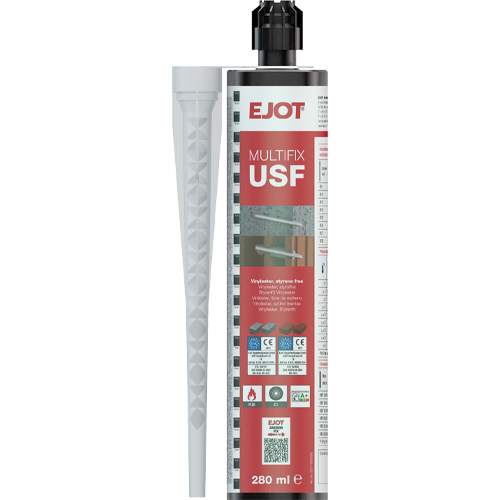
Multifix USF Vinylester 420 Chemical Anchor – 420ml
Multifix USF Vinylester 420 Chemical Anchor – 420ml
Multifix USF 420 Price in Kenya – KSh 4,350 Inclusive of VAT
Multifix USF Vinylester 420 is a professional-grade, styrene-free vinylester injection mortar designed for reliable chemical anchoring and fixing in concrete and masonry. Available from Startcore Ventures in Nairobi at KSh 4,350 per 420ml cartridge inclusive of VAT, the system is suited to contractors, structural installers, steel fabricators, M&E contractors, civil works teams, façade installers and professional construction companies that need a dependable chemical anchoring solution.
The product is supplied as a 420ml cartridge with its dedicated caulking gun, giving contractors a practical installation package rather than requiring the resin and application equipment to be sourced separately.
Multifix USF is particularly useful where conventional mechanical expansion anchors are not the preferred solution. Instead of relying on expansion pressure against the sides of a drilled hole, chemical anchoring creates a bonded connection between the anchor rod or reinforcement element and the surrounding substrate.
The result is a professional anchoring method for applications where correct drilling, hole cleaning, resin injection, anchor installation and curing are critical to achieving the specified fixing performance.
EJOT identifies Multifix USF as a styrene-free vinyl resin injection system suitable for installation in cracked and non-cracked concrete as well as masonry. The manufacturer also states that the system can be used in wet concrete and water-filled drill holes, subject to the applicable approval and installation parameters.
Why Use Multifix USF 420 for Chemical Anchoring?
Chemical anchoring is often selected when a project requires a more controlled bonded fixing than a conventional mechanical anchor can provide.
A mechanical expansion anchor works by physically expanding inside the drilled hole. A chemical anchor works differently. The resin is injected into the prepared hole and the threaded rod, reinforcing bar or approved fixing element is inserted into the resin. Once the resin cures, the fixing becomes bonded to the surrounding substrate.
This approach can be especially useful for professional construction and installation work where:
- High-quality concrete or masonry fixing is required
- The fixing needs to be installed close to an edge, subject to design requirements
- Expansion pressure from a mechanical anchor is undesirable
- Threaded rods need to be installed into concrete
- Reinforcement connections require a specified approved system
- Fixings are required in cracked or non-cracked concrete
- Fixings are required in masonry
- Wet concrete or water-filled drilled holes are encountered
- Contractors need a professional injection system rather than a basic adhesive
Multifix USF 420 provides a practical solution for these applications when installed according to the manufacturer's technical documentation and the applicable approval requirements.
It should not, however, be treated as a generic construction adhesive. Chemical anchoring is an engineered fixing method. Hole diameter, embedment depth, anchor diameter, substrate condition, installation temperature, cleaning procedure, curing time and applied load all matter.
For safety-critical or structural applications, the fixing should always be designed and installed according to the relevant engineering requirements and the manufacturer's approved installation parameters.
Multifix USF 420 – Professional Vinylester Chemical Anchor
Multifix USF uses a styrene-free vinylester resin formulation. This places it within the professional chemical anchoring category used for bonded fastening into concrete and masonry.
The 420ml cartridge format is particularly useful for contractors carrying out multiple anchor installations because it provides a larger quantity of resin than smaller cartridges and is designed for use with an appropriate dispensing system.
The cartridge contains the two-component reactive mortar. The components remain separated until they pass through the mixing nozzle. During application, the components are proportioned and mixed through the nozzle, producing the reactive anchoring mortar.
This means the contractor does not have to manually mix resin and hardener before installation.
The dedicated dispensing system also allows the installer to control the quantity of mortar injected into each hole.
For larger projects, this can make chemical anchoring more consistent and easier to manage than improvised application methods.
420ml Cartridge for Professional Installation
The 420ml format is designed for professional anchoring work where several fixing points may be required.
EJOT lists the Multifix USF 420ml cartridge under article number 9571001420 and identifies the material as a styrene-free vinylester composite mortar. The standard 420ml cartridge is supplied with a mixing nozzle.
At Startcore, the product is supplied with its dedicated caulking gun, giving the buyer the equipment required to dispense the cartridge correctly.
This is important because purchasing only the resin cartridge without the correct dispensing equipment can delay installation or lead contractors to improvise with incompatible applicators.
With the cartridge and dedicated gun supplied together, the system is much easier to procure for a site team.
What you receive
Multifix USF Vinylester 420 package:
- 1 × Multifix USF 420ml chemical anchor cartridge
- Dedicated caulking gun for the cartridge
- Mixing nozzle for controlled resin application
Always check the cartridge, nozzle and dispensing gun before beginning installation.
Multifix USF for Concrete Anchoring
Concrete is one of the most common substrates for chemical anchoring.
Construction projects regularly require threaded rods, steelwork, brackets, equipment supports, railings, service supports and other components to be fixed into existing concrete.
In many retrofit situations, the concrete has already cured and the contractor needs to introduce a new fixing without casting a new section of concrete.
Chemical anchoring provides a practical way of creating that connection.
Multifix USF is approved for installation in cracked and non-cracked concrete under the applicable ETA conditions. EJOT's published installation information provides anchor-rod sizes and embedment ranges for approved configurations.
The manufacturer's published installation parameters include anchor rods from M8 through M30, with permitted embedment depths varying according to the anchor diameter and approved installation configuration.
This makes Multifix USF relevant to a wide range of professional anchoring work.
However, contractors should never select an anchor diameter or embedment depth simply because it is physically possible. The correct fixing must be selected according to the design load, substrate, edge distances, spacing, embedment and the applicable approval.
Chemical Anchoring in Cracked and Non-Cracked Concrete
One of the important advantages of an approved chemical anchoring system is its suitability for defined concrete conditions.
Concrete can contain cracks, particularly in existing structures, slabs, beams and other construction elements. A chemical anchor approved for cracked concrete can therefore provide an anchoring option where a product without that approval may not be appropriate.
EJOT lists Multifix USF under ETA-16/0107 for installation in cracked concrete and non-cracked concrete. The applicable approval must always be checked for the intended application.
For professional contractors, this is important because the product should not be selected based solely on the words “vinylester chemical anchor.”
The exact approval, anchor diameter, embedment depth, substrate and installation conditions must match the job.
Startcore can help contractors identify the appropriate chemical anchoring product for the application.
Multifix USF for Masonry Anchoring
Multifix USF is also approved for defined masonry applications.
Masonry presents different challenges from solid concrete. Bricks, blocks and other masonry units can vary significantly in density, strength, void configuration and condition.
For hollow or perforated masonry, a suitable mesh sleeve system may be required so that the resin forms the appropriate mechanical and bonded connection around the fixing.
EJOT's published information includes mesh-sleeve configurations for Multifix USF in perforated building materials.
This is why contractors should not simply drill into a hollow block and inject resin without checking the installation system.
The correct process may involve:
- Selecting the correct fixing diameter.
- Drilling the specified hole.
- Cleaning the hole properly.
- Installing the appropriate mesh sleeve where required.
- Injecting the correct quantity of resin.
- Inserting the anchor rod correctly.
- Allowing the resin to cure.
- Applying the load only after the required curing period.
The exact installation method should follow the manufacturer's approved procedure.
Wet Concrete and Water-Filled Drill Holes
Construction sites are not always dry.
Contractors working on foundations, basements, external structures and renovation projects may encounter damp concrete or drilled holes containing water.
EJOT identifies Multifix USF as suitable for use in wet concrete and water-filled drill holes, subject to the manufacturer's approved installation conditions.
This can be an important advantage when compared with products that require completely dry conditions.
However, “suitable for wet conditions” does not mean that contractors can ignore hole preparation.
The hole still needs to be drilled to the correct dimensions and cleaned properly. Water, dust, loose particles and drilling residue can affect installation quality if the approved procedure is not followed.
For critical anchoring, the installation method should always be taken directly from the applicable technical documentation and approval.
Correct Hole Preparation Is Critical
A professional chemical anchor is only as good as the installation.
One of the most common mistakes in chemical anchoring is focusing heavily on the resin while treating hole cleaning as an afterthought.
That is a mistake.
When a hole is drilled into concrete, the drilling process creates dust and loose material. If that material remains inside the hole, the resin may bond to the contamination rather than forming the intended connection with the substrate.
A professional installation therefore requires the hole to be prepared according to the manufacturer's specified cleaning procedure.
Typical chemical-anchor installation involves:
Drill → Clean → Blow → Brush → Clean again → Inject → Insert → Cure → Load
The exact cleaning sequence, tools and number of cleaning cycles should follow the applicable Multifix USF installation instructions.
For contractors, Startcore can also supply the wider installation workflow, including professional drilling equipment and accessories.
A Bosch SDS-Plus rotary hammer, for example, can be used for the drilling stage where the selected bit and tool are appropriate for the hole diameter and substrate. Startcore stocks Bosch professional rotary hammers for this type of construction work.
Pair Multifix USF with the Right Drilling Equipment
Chemical anchoring starts before the resin reaches the hole.
The quality and accuracy of the drilled hole matter.
For general concrete drilling and anchor preparation, the Bosch GBH 220 Rotary Hammer is a practical professional tool for contractors working with SDS-Plus accessories. Startcore lists the GBH 220 at KSh 20,100 inclusive of VAT.
For heavier professional drilling work, the Bosch GBH 2-24 DRE Rotary Hammer is another option available from Startcore.
This creates a natural procurement combination:
Bosch SDS-Plus Rotary Hammer + Correct SDS-Plus Drill Bit + Hole-Cleaning Equipment + Multifix USF 420 + Anchor Rod
Instead of buying the chemical anchor in isolation, contractors can source the complete anchoring workflow from one supplier.
That is particularly useful for contractors starting a new installation project and trying to avoid site delays caused by missing accessories.
Multifix USF 420 for Threaded Rod Installation
Chemical anchoring is frequently used with threaded rods.
The threaded rod is inserted into the resin-filled hole and becomes bonded to the substrate after curing.
Depending on the application, threaded rods can be used for fixing:
- Steel brackets
- Support frames
- Cable trays
- Pipe supports
- M&E installations
- Handrails
- Guardrails
- Equipment supports
- Structural steel connections
- Service installations
- Plant and machinery supports
- Canopies
- Signage structures
- Building services
- Fabricated steel components
The specific application must be checked against the approved load and installation parameters.
Do not assume that a chemical anchor is automatically suitable for every structural connection simply because it is described as “high strength.”
For load-bearing applications, engineers and installers should select the appropriate anchor configuration based on the project design.
Multifix USF for Rebar and Reinforcement Applications
Chemical anchoring systems can also be used for defined reinforcement applications.
EJOT's published documentation includes approval information for reinforcement connections associated with Multifix USF.
This can be relevant in construction and structural modification projects where reinforcement needs to be introduced into an existing concrete element.
Typical applications may include defined reinforcement connections, extensions and structural modification work where the applicable engineering design and approval requirements are satisfied.
This is an area where professional design is especially important.
Rebar diameter, embedment depth, concrete strength, spacing, edge distances, installation temperature and design loads all influence the performance of a bonded reinforcement connection.
For structural reinforcement work, always work from the applicable engineer's design and the manufacturer's approval documentation.
Multifix USF vs Mechanical Expansion Anchors
The biggest difference between chemical anchoring and mechanical expansion anchoring is how the fixing transfers load to the substrate.
A mechanical anchor relies on mechanical expansion.
A chemical anchor relies on the cured resin bonding the fixing element to the substrate.
This distinction can make chemical anchoring attractive in situations where the contractor wants to avoid expansion forces associated with certain mechanical fixing systems.
Chemical anchoring can also provide flexibility in selecting embedment depths and fixing arrangements within the manufacturer's approved design range.
But chemical anchors are more installation-sensitive.
A mechanical anchor may be relatively straightforward to install.
A chemical anchor requires:
- Correct drilling
- Correct hole diameter
- Correct hole depth
- Proper hole cleaning
- Correct resin injection
- Correct anchor insertion
- Correct embedment
- Correct curing time
- Correct loading procedure
The contractor therefore needs to treat chemical anchoring as a complete installation system.
Multifix USF 420 vs Other Chemical Anchors
Startcore stocks several chemical anchoring solutions because different projects require different resin technologies, cartridge sizes and performance characteristics.
For example, Akfix C900 Chemical Anchor is another option available through Startcore for professional chemical anchoring. The Startcore range also includes Akfix C920, Sika AnchorFix 1, Fischer FIS V Plus and PU Star Struct EP870.
The correct product depends on the project.
Multifix USF is particularly attractive when the specification calls for an approved styrene-free vinylester system suitable for defined concrete and masonry applications.
Sika AnchorFix 1 is another chemical anchoring option stocked by Startcore and is currently listed at KSh 2,500 for the 300ml cartridge.
Fischer FIS V Plus is also available in the Startcore chemical-anchor range.
For procurement teams, this means Startcore can help compare the available anchoring systems rather than forcing every project into one resin type.
Professional Installation Sequence
A successful Multifix USF installation should be treated as a controlled process.
1. Confirm the design
Before drilling, confirm the anchor diameter, embedment depth, hole diameter, substrate and required load.
2. Mark the fixing point
Accurately mark the position of the anchor.
Check edge distances and spacing before drilling.
3. Drill the hole
Use an appropriate drill and bit for the specified hole diameter and depth.
Avoid enlarging or damaging the hole unnecessarily.
4. Clean the hole
Remove drilling dust and loose material using the specified cleaning procedure.
For critical installations, do not skip this stage.
5. Prepare the cartridge
Install the Multifix USF 420 cartridge into the dedicated dispensing gun.
Fit the mixing nozzle correctly.
6. Purge the initial material
Follow the manufacturer's instructions regarding initial material that has not been properly mixed.
The resin should be properly mixed before entering the anchor hole.
7. Inject the resin
Inject the required quantity from the bottom of the hole outward where the installation procedure calls for this method.
Avoid creating large air pockets.
8. Insert the anchor
Insert the threaded rod or approved fixing element using the specified method.
Ensure it reaches the required embedment.
9. Allow curing
Do not load the fixing before the required curing time.
Curing time depends strongly on temperature and installation conditions.
10. Apply the load
Only load the anchor once the required curing period has been achieved and the installation has been completed according to the approved system.
Curing Time Matters
One of the most important differences between chemical anchoring and ordinary construction adhesives is the importance of curing time.
Multifix USF's published installation data shows curing time changes significantly with temperature. EJOT lists processing and curing times for different ambient temperatures, ranging from much longer curing periods at lower temperatures to substantially shorter periods at higher temperatures.
For example, the published data gives dry-weather curing times of approximately:
- 24 hours at -10°C
- 14 hours at -5°C
- 7 hours at 0°C
- 2 hours at +5°C
- 1 hour 20 minutes at +10°C
- 45 minutes at +20°C
- 25 minutes at +30°C
- 20 minutes at +35°C
- 15 minutes at +40°C
Wet-weather curing times are longer.
These figures demonstrate why contractors should never assume that an anchor is ready simply because the resin appears firm.
The curing condition must be checked against the manufacturer's technical documentation.
Multifix USF 420 for Kenyan Construction Projects
Kenya's construction environment creates a wide variety of anchoring requirements.
From commercial buildings and apartment developments in Nairobi to warehouses, factories, schools, hospitals, infrastructure projects and industrial installations, contractors regularly need to install new fixtures into existing concrete and masonry.
Chemical anchors can be particularly useful during:
- Building refurbishment
- Commercial fit-outs
- M&E installation
- Industrial maintenance
- Structural modifications
- Steel fabrication
- HVAC installation
- Electrical installations
- Plumbing support systems
- Façade works
- Handrail installation
- Equipment installation
- Plant maintenance
- Warehouse construction
- Infrastructure works
For Nairobi contractors working around Industrial Area, Embakasi, Westlands, Upper Hill, Kilimani, Ruaraka, Thika Road and surrounding construction zones, having the resin, dispensing equipment and drilling tools available from one supplier can simplify procurement.
Startcore supplies construction chemicals and professional tools with a contractor-focused approach rather than treating chemical anchoring as a simple retail adhesive purchase.
Why Buy Multifix USF 420 from Startcore?
The biggest advantage of buying a professional chemical anchoring system from a construction-solutions supplier is that you can source more than the cartridge.
Startcore can help contractors build the complete installation package.
This can include:
- Chemical anchor resin
- Dedicated dispensing gun
- SDS-Plus rotary hammer
- SDS-Plus drill bits
- Hole-cleaning accessories
- Threaded fixing systems where available
- PPE
- Complementary construction chemicals
- Alternative chemical-anchor systems
That matters because chemical anchoring is not simply about choosing the resin.
The correct result depends on the complete installation process.
Related Chemical Anchor Products
If Multifix USF is not the exact resin required for your project, Startcore stocks several alternatives.
Akfix C900 Chemical Anchor
Akfix C900 is a professional chemical anchoring option available in Startcore's chemical-anchor range.
It is useful for contractors looking for an alternative resin system for concrete and masonry anchoring.
Akfix C920 Chemical Anchor
For applications requiring a different two-component injection mortar option, Startcore also stocks Akfix C920.
Sika AnchorFix 1
Sika AnchorFix 1 is another established chemical-anchor option for professional fixing work. Startcore currently lists the 300ml cartridge at KSh 2,500 inclusive of VAT.
Fischer FIS V Plus
Startcore also stocks Fischer FIS V Plus injection mortar, giving contractors another professional option when specifying chemical anchors.
The important point is that these products should not be treated as interchangeable purely because they all fall under “chemical anchor.”
Always check the technical approval and application requirements before substituting one product for another.
Complete Chemical Anchoring Workflow
For a contractor installing a steel bracket into concrete, the purchasing list could look like this:
1. Drill
Use an appropriate Bosch rotary hammer and SDS-Plus drill bit.
2. Clean
Prepare the hole using the required cleaning equipment.
3. Anchor
Use Multifix USF 420 with the dedicated dispensing gun.
4. Fix
Insert the specified threaded rod or approved fixing element.
5. Cure
Wait for the manufacturer's specified curing time.
6. Load
Install the steelwork, bracket, support or equipment only after the anchor has achieved the required cure.
This is the type of complete solution Startcore is designed to support.
Who Should Buy Multifix USF 420?
Multifix USF 420 is suited to professional users including:
Structural contractors
For defined bonded anchoring and reinforcement applications.
Steel fabricators
For installing fabricated steelwork, brackets and support structures where chemical anchoring is specified.
M&E contractors
For fixing equipment supports, pipework, cable trays and other building-service installations.
HVAC contractors
For mounting approved support systems and brackets into concrete and masonry.
Electrical contractors
For equipment, cable support and installation systems requiring bonded fixing.
Plumbing contractors
For pipe supports and service installation work.
General contractors
For professional construction and renovation applications requiring chemical anchoring.
Maintenance contractors
For retrofit and repair work where new fixings must be installed into existing concrete or masonry.
Civil contractors
For approved anchoring and reinforcement applications.
Multifix USF 420 Price in Kenya
Multifix USF Vinylester 420 – KSh 4,350 inclusive of VAT per cartridge.
The package supplied by Startcore includes the dedicated caulking gun, making it easier for contractors to purchase the complete dispensing setup with the resin.
For project quantities, contractors should contact Startcore for availability and procurement support.
If your project requires multiple anchors, we can also help you determine whether the 420ml cartridge format is suitable for the required number of fixing points.
EJOT provides a Multifix calculation tool intended to help estimate the number of mortar cartridges required based on anchor diameter, number of holes and drilling depth.
Do You Need Multifix USF or Another Chemical Anchor?
Not every chemical anchor is right for every project.
When ordering, tell us:
- What you are fixing
- Concrete or masonry substrate
- Cracked or non-cracked concrete
- Anchor rod diameter
- Approximate embedment depth
- Number of fixing points
- Whether the holes are dry, damp or water-filled
- Indoor or outdoor installation
- Expected load
- Whether the application is structural
This allows Startcore to help identify the appropriate product rather than simply selling the most expensive cartridge.
For engineered structural applications, the final anchor selection and design must be made by the responsible engineer in accordance with the applicable approval and project requirements.
Frequently Asked Questions
What is Multifix USF 420?
Multifix USF 420 is a 420ml styrene-free vinylester injection mortar used for professional chemical anchoring in approved concrete and masonry applications.
What is the price of Multifix USF 420 in Kenya?
The Startcore price is KSh 4,350 inclusive of VAT per cartridge.
Does the Multifix USF 420 come with a caulking gun?
Yes. The Startcore package is supplied with the dedicated caulking gun for dispensing the cartridge.
Is Multifix USF a chemical anchor?
Yes. It is an injection mortar used as part of a chemical anchoring system.
Can Multifix USF be used in concrete?
Yes. EJOT lists the system for approved installations in cracked and non-cracked concrete.
Can Multifix USF be used in masonry?
Yes. EJOT also lists approved masonry applications.
Can it be used in wet concrete?
EJOT states that Multifix USF can be used in wet concrete and water-filled drill holes, subject to the applicable installation requirements.
What anchor sizes can be used?
EJOT's published installation parameters include approved anchor rods from M8 to M30, with the permitted embedment depending on the anchor size and installation configuration.
Can I use Multifix USF for structural work?
It can be used for approved structural anchoring applications, but the specific application must be designed and installed according to the applicable ETA, technical documentation and engineering requirements.
How long does Multifix USF take to cure?
Curing time depends on temperature and whether the installation is dry or wet. EJOT's published data ranges from minutes at warmer temperatures to many hours at lower temperatures.
Can I load the anchor immediately?
No. The anchor must be allowed to cure for the required time before loading.
Does hole cleaning matter?
Yes. Proper hole preparation is a critical part of chemical-anchor installation.
Can I use any caulking gun?
The cartridge requires a compatible dispensing system. The Startcore package includes the dedicated caulking gun to make application straightforward.
What other chemical anchors does Startcore stock?
Startcore also stocks chemical anchoring products including Akfix C900, Akfix C920, Sika AnchorFix 1, Fischer FIS V Plus and PU Star Struct EP870.
Can Startcore supply the drilling equipment too?
Yes. Startcore stocks Bosch Professional rotary hammers suitable for professional concrete and masonry drilling, including the Bosch GBH 220 and GBH 2-24 DRE.
Order Multifix USF Vinylester 420 in Kenya
If you need a professional chemical anchor for concrete or masonry, Multifix USF Vinylester 420 provides a professional styrene-free vinylester injection system for approved anchoring applications.
Price: KSh 4,350 inclusive of VAT per cartridge
Package includes:
- Multifix USF 420ml cartridge
- Dedicated caulking gun
- Mixing nozzle
Whether you are fixing steelwork, installing M&E supports, carrying out structural modifications, installing brackets or working on a larger construction project, Startcore can help you put together the complete anchoring system.
Need the right chemical anchor for your project? Tell us what you are fixing, the substrate and the anchor size. We can help you identify the appropriate system and related installation products.
Startcore Ventures Limited
Construction Products + Technical Expertise
Nairobi, Kenya
Kenya-wide delivery available


